Showing posts with label Malaysia. Show all posts

Monday, 12 March 2012

Changing times

My last day in Malaysia and Chow Boi has arranged a really interesting trip for me to visit a cocoa farm and meet some interesting industry folk.


We climbed out of Kuala Lumpur – into the Titiwangsa Mountains, home to the Genting Highland resorts. This is a very beautiful drive - wonderful forest in these hills, and cool. We meet up with a whole group of cocoa industry movers and shakers; they are all good friends and associates and have been involved in cocoa for many years.


We head off to a small town and meet Kou – a farmer who is also a trader. We meet him in his ‘shop’ full of cocoa bean sacks, and then head off to see his farm – and end up in a beautiful valley – with forest on the upper slopes, and cocoa and palm oil at the base of the valley. Kou’s cocoa farm is exemplary – he has been farming here since the mid 80s and the trees are extremely well managed and cared for. He can get 3000kg from a hectare through good management – including grafting, pruning, spraying against disease, and good hygiene. He is an innovative and intuitive farmer – taking on ideas from experts and then developing them further to work for him.

 
However, after 28 years in cocoa, he is about to give this all up and next year will replace the cocoa trees with oil palm. There are many reasons for this; the main one he gave was that he just cannot get the labour needed to work his plantations. Cocoa needs one person per hectare to carry out the intense management needed to ensure good harvest; Malaysians do not wish to work on farms, and so the only labour available is immigrant – but the government manages this very tightly and according to a model based mainly on oil palm – in which one person can manage 10 ha. So Kou finds it difficult to attract labour, train them (tending cocoa is very skilled) and then retaining them. He feels it is time he needs to step back from the farm (he is in his 60s) and so oil palm will provide his pension. Cocoa costs MR6000 a year/ha to produce and sells at only MR7000 a year/ha. The economics of oil palm are very different and earn a great deal more.
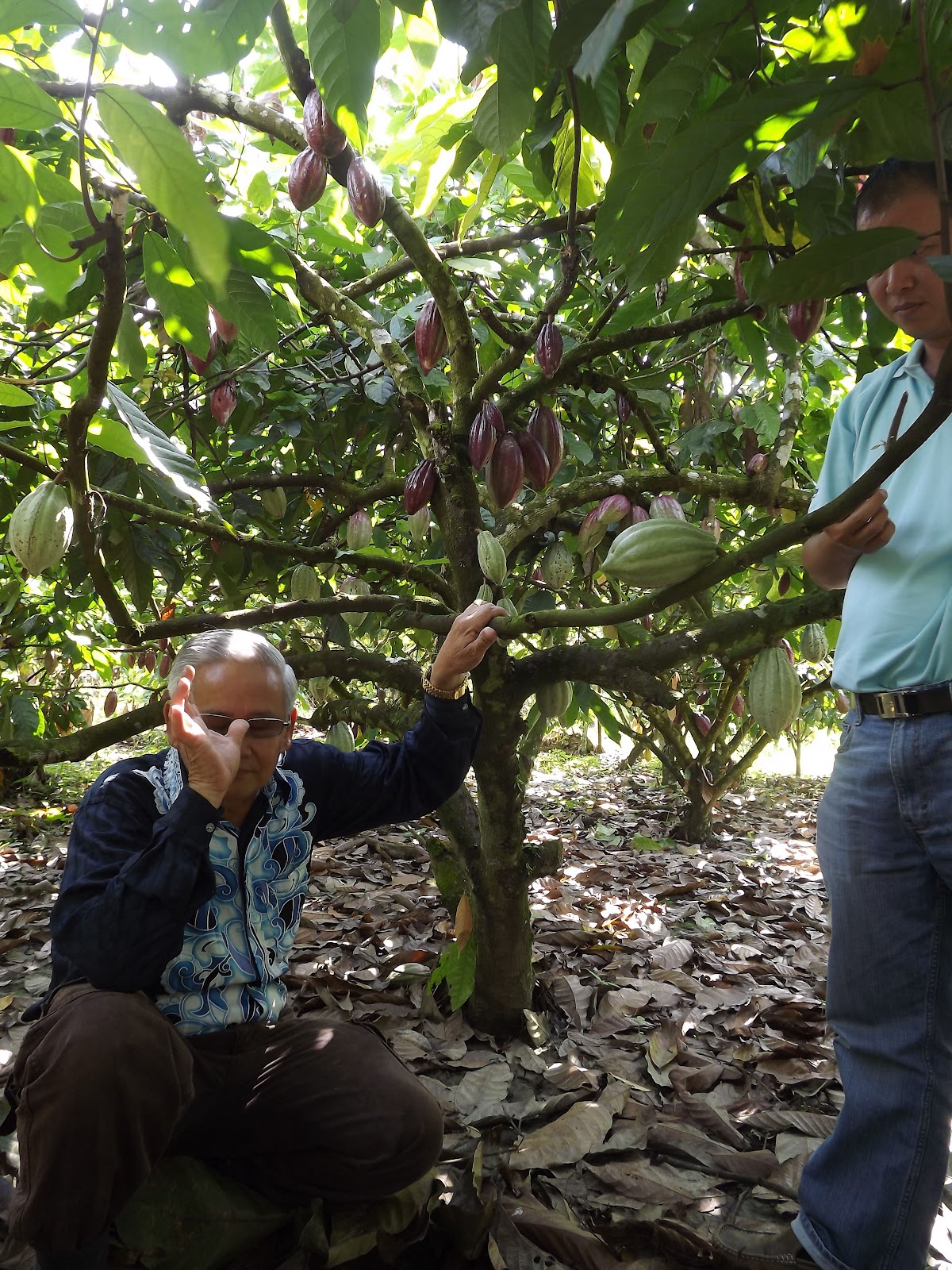

Our talk that day was mainly about this – the last death throws of the cocoa industry in Malaysia. The Malaysian Cocoa Board claims that the annual production is 20,000ha, but no-one I met that day could identify where that production came from. Cocoa is disappearing fast, being replaced mainly by oil palm, but also rubber. The talk was about resisting being sentimental about this, but the need to look to the future and the industry’s need to focus elsewhere on securing future cocoa supplies. Hence the industry’s focus on work with small holders in Indonesia, and also on the new ‘wild east’ of cocoa production – Vietnam and the Phillipines.


Wednesday, 15 February 2012

To ferment or not ferment – that is the question

Back in Kuala Lumpur now – we travelled from Singapore on a sleeper train! Most everyone you mention this to automatically asks you why you aren’t taking the bus! Indeed, the berths had seen better days – but it was comfortable and there were very civilized elements to the whole experience that made it very enjoyable. For example, I had never gone over an international border on a train before and had immigration coming through the train checking passports, and so avoided endless queues and electronic gadgets taking photos and finger prints; took me back to James Bond and spy movies of my choldhood set in Europe where this always seemed to be a sticky moment for the hero or villain in some way.

I have been really fortunate to have been put in touch with Chow Boi Yee, here in Malaysia, who has worked in the cocoa industry in this region for years, and I met him to learn more about the cocoa industry in this part of the world. Chow Boi’s experience of the region is really fantastic and I have now a much better sense of what might be possible on this trip. The meeting to some extent settled a niggling anxiety that I have that I might be wasting people’s time – the amounts of cocoa that I would be able to buy and use are so small compared to the scale of the industry here.

There are a number of issues here, and the main one is how the cocoa is processed once it is harvested. When cocoa beans are removed from the pods they are covered in a sweet white pulp that is attached to them. The easiest way to remove this is to let it rot away, and this is done by piling the beans up and letting the pulp ferment and rot away. This fermentation process is also critical in bringing out many of the flavours that we value in chocolate, so managing this and getting the most out of the process in terms of potential flavour is important if you are interested in using the beans for making chocolate.

However, most of the crop in this region is valued more for its cocoa butter – it tends to have a higher melting point than cocoa butter grown elsewhere and so is favoured by the chocolate industry as it means that chocolate will cool and harden quicker - useful on a conveyor production line. The cocoa flavour is less important when it is the butter that is the focus and so the fermentation is less important. Most beans here are therefore termed ‘unfermented’; there has in fact been a 2 day quick fermentation to remove the white pulp before drying the beans for export, but to bring out good flavour, 5 to 7 days of controlling the temperature and the fermentation process is needed.

So the quest will be to find farmers – and the cocoa is predominantly grown on small holdings – who have the skills to do a complete fermentation, and would be able to supply me with 100kg of beans.

Another issue here is that the cocoa industry is on the decline – partly because of some nasty pests and diseases over the last few years – but also because it is easier to make an income from palm oil than cocoa. It takes one person to tend 1ha of cocoa, but that person could tend 10ha of palm oil. Far more cost effective.