My second trip to Indonesia started with a ferry across the Clyde! I had been at the National Mod with winning choir (no desire here to be modest – Go Aberfeldy and District Gaelic Choir) held this year in Dunoon. Buoyed by success at the Mod, I hoped that this trip would be a good one – and I would come home this time with beans.
Jakarta’s heat and bustle does not hit you immediately when you arrive at the airport - it is a calm, unhurried pace – until you emerge to the outside world and suddenly everyone wants your attention - luggage handlers, taxi drivers - or indeed brokers; all vying for your trade. My friends had emphasised to me that I should only go with Blue Bird – but all taxi drivers now seem to wear blue shirts and have companies that sound a little like Blue Bird – Flying Bird, Blue Taxi. Momentarily misguided I found myself being lead into a vast parkng lot and realised that the blue shirted, Blue Bird ID tag driver leading me – was not the real thing. Back to the real Blue Bird queue, thankful that I had been here before and my friend’s advice had been so emphatic.
My trip to their house was quite quick – less than an hour. Last Friday evening my husband’s trip took 2.5 hours! The traffic is so notoriously gridlocked that people take their office with them – sitting in the car with 3G internet connections for laptops and mobile phones. There is even a business that plans to use this captive audience for advertising – using those back of the chair TV screens. Few hawkers though – unlike 20 years ago in Lagos, Nigeria, where traffic was as notorious and stuck in your car hawkers would bring you newspapers, food, groceries, this and that and in the early days of mobile phones a mobile telephone service!
Saturday, 27 October 2012

Thursday, 6 September 2012
The Milky Bar kid has come to town..
I know that chocolate makers
are supposed to be snooty and ‘its not really chocolate’ about white chocolate
– but sometimes white chocolate is what you need to set off a particular
flavour. Some time ago a very lovely HB Ingredient lady suggested I try El Rey ICOA
chocolate and my eyes were opened to a much more interesting white
chocolate world.
White chocolate is chocolate
with cocoa butter but without any of the other cocoa solids. Cocoa
beans are 50% fat – this glorious cocoa butter is what gives chocolate all its
magical physical properties – its body-temperature melt and its well-tempered
snap. To get the cocoa butter, the
cocoa beans are pounded and then pressed – to separate the butter from the
other cocoa solids. For some reason, the cocoa
butter then goes through some weird ‘de-odorising’ process to create a
flavourless white fat. And this is then
what goes into white chocolate.
So, what was great about El
Rey’s white chocolate was that they did not de-odorise the cocoa butter and you
definitely taste this in the white chocolate – yes it was sweet and a wee bit
sickly – but there was also this interesting floral flavour – something else
there. It tempered to the sharpest snap as well – and made a wonderful canvas
for the wild flower flavours that I was using.
However, HB then told me
that they were discontinuing El Rey
products – the import of their products had been too haphazard. I had come across a Columbian company at the Paris‘Salon du Chocolat’ last October, Luker, who also did not use de-odorised cocoa butter. HB Ingredients sent me some samples with some others – Belcolade,
l’Opera du Chocolat, etc. At first I
did not like any of them, but after persevering decided that the Luker Sierra
would do. I have since grown to love it
– again it tempers beautifully and works well with the flowers.
However, DISASTER – HB
Ingredients now tell me that they will no longer be importing Luker Sierra.
Back to the search all over again.
They have sent more samples: Luker Nevado, Belcolade, Spanish.
I have been tasting these –
but nothing seems to fit the bill. I
have tasted them together, then one after the other – but they all seem like
Milky Bars; I try taking them by surprise – popping a callette in my mouth as I
walk past the shelf – but no – still Milky Bar. The little lad with the round glasses and cowbay suit is haunting
my workshop.
Back to HB Ingredients and a
visit from their Scotland rep and a long phone call with David at their office
and I am a lot wiser but no nearer a batch of Sierra. David tells me that this was made for the Japanese market, has
low milk contact (and so higher cocoa butter content) and low vanilla. So this is clearly why it doesn’t taste like
Milky Bar.
So, used the last of the
Sierra today and very very sad. I think
I will have to go for the Nevado – very interested in the Luker story so would
be happy to use this. But it is not
perfect, and I will continue to nag about the Sierra!
Monday, 12 March 2012
Changing times
My last day in Malaysia and Chow Boi has arranged a really interesting trip for me to visit a cocoa farm and meet some interesting industry folk.
We climbed out of Kuala Lumpur – into the Titiwangsa Mountains, home to the Genting Highland resorts. This is a very beautiful drive - wonderful forest in these hills, and cool. We meet up with a whole group of cocoa industry movers and shakers; they are all good friends and associates and have been involved in cocoa for many years.
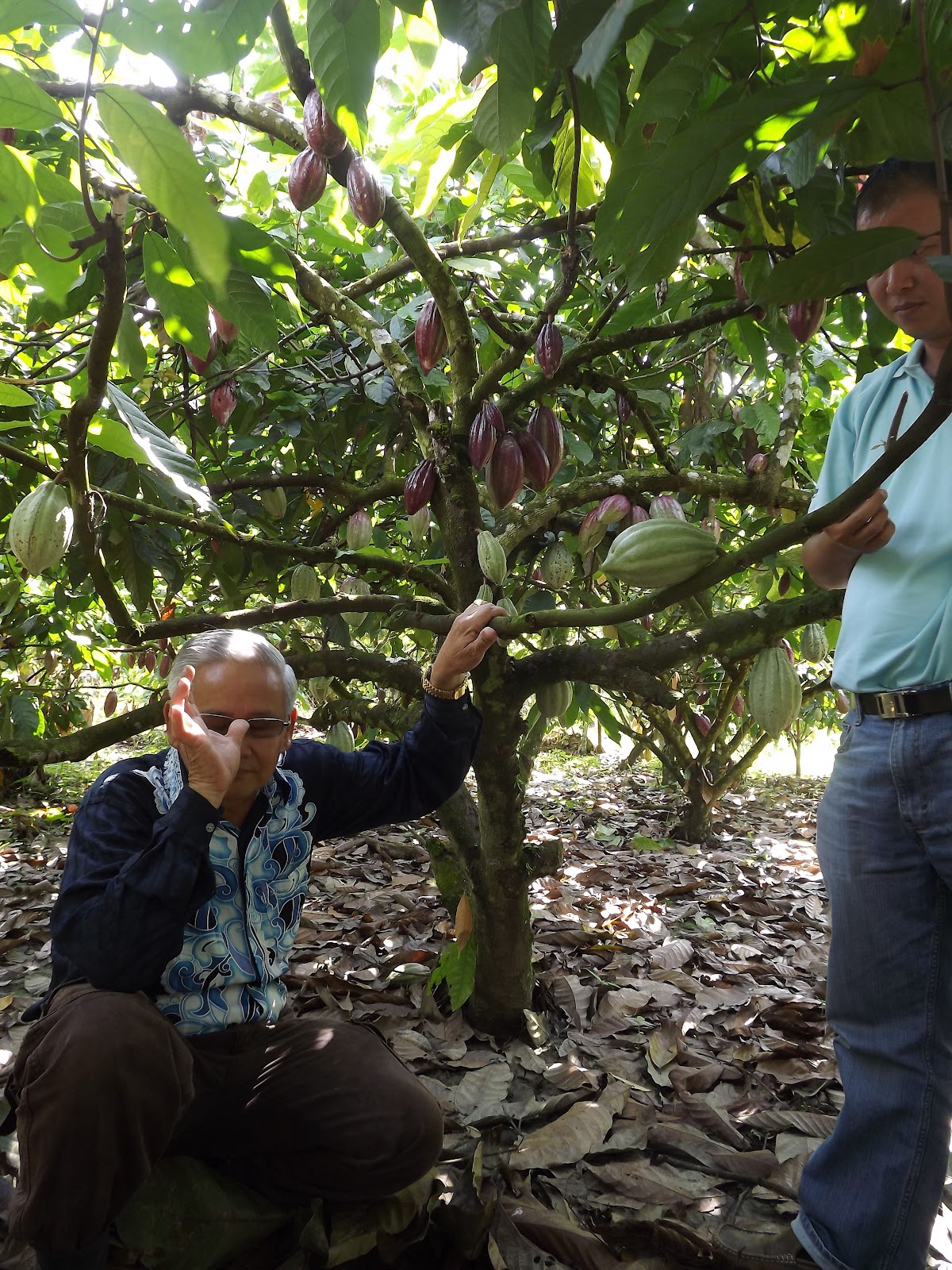
We head off to a small town and meet Kou – a farmer who is also a trader. We meet him in his ‘shop’ full of cocoa bean sacks, and then head off to see his farm – and end up in a beautiful valley – with forest on the upper slopes, and cocoa and palm oil at the base of the valley. Kou’s cocoa farm is exemplary – he has been farming here since the mid 80s and the trees are extremely well managed and cared for. He can get 3000kg from a hectare through good management – including grafting, pruning, spraying against disease, and good hygiene. He is an innovative and intuitive farmer – taking on ideas from experts and then developing them further to work for him.

Our talk that day was mainly about this – the last death throws of the cocoa industry in Malaysia. The Malaysian Cocoa Board claims that the annual production is 20,000ha, but no-one I met that day could identify where that production came from. Cocoa is disappearing fast, being replaced mainly by oil palm, but also rubber. The talk was about resisting being sentimental about this, but the need to look to the future and the industry’s need to focus elsewhere on securing future cocoa supplies. Hence the industry’s focus on work with small holders in Indonesia, and also on the new ‘wild east’ of cocoa production – Vietnam and the Phillipines.

We climbed out of Kuala Lumpur – into the Titiwangsa Mountains, home to the Genting Highland resorts. This is a very beautiful drive - wonderful forest in these hills, and cool. We meet up with a whole group of cocoa industry movers and shakers; they are all good friends and associates and have been involved in cocoa for many years.
We head off to a small town and meet Kou – a farmer who is also a trader. We meet him in his ‘shop’ full of cocoa bean sacks, and then head off to see his farm – and end up in a beautiful valley – with forest on the upper slopes, and cocoa and palm oil at the base of the valley. Kou’s cocoa farm is exemplary – he has been farming here since the mid 80s and the trees are extremely well managed and cared for. He can get 3000kg from a hectare through good management – including grafting, pruning, spraying against disease, and good hygiene. He is an innovative and intuitive farmer – taking on ideas from experts and then developing them further to work for him.
However, after 28 years in cocoa, he is about to give this all up and next year will replace the cocoa trees with oil palm. There are many reasons for this; the main one he gave was that he just cannot get the labour needed to work his plantations. Cocoa needs one person per hectare to carry out the intense management needed to ensure good harvest; Malaysians do not wish to work on farms, and so the only labour available is immigrant – but the government manages this very tightly and according to a model based mainly on oil palm – in which one person can manage 10 ha. So Kou finds it difficult to attract labour, train them (tending cocoa is very skilled) and then retaining them. He feels it is time he needs to step back from the farm (he is in his 60s) and so oil palm will provide his pension. Cocoa costs MR6000 a year/ha to produce and sells at only MR7000 a year/ha. The economics of oil palm are very different and earn a great deal more.

Thursday, 8 March 2012
A school for chocolate
How lucky I was to come across Mervyn – he seems to be close to the heart of a really exciting movement to raise the chocolate game in Indonesia, and he very kindly arranged for me to meet two of the critical actors in this. William Chuang is one of the Managing Directors of Petra Foods; his father started the company and so he has lived and breathed cocoa all his life, cocoa flows through his veins. It was such a treat to meet someone not only so knowledgeable about the business – all the ins and outs of the international cocoa trade, the many issues facing the industry – but also who really likes chocolate and is as committed to raising awareness about how fantastic it can beas he is to making sure the business runs effectively.
He had a dream to set up a chocolate school and has achieved that – a school where professionals and amateurs can learn more about getting the most out of chocolate. His next ambition is for a chocolate museum – which if the School is a measure to go by – will be fantastic.

The Chocolate School is run by Andy Van Den Broeck, a Belgian chocolate maker who has the fantastic job of both running the school but also consultant to the Indonesian chocolate companies in the Petra Foods family. He kindly agreed to show me the school on Saturday and I had a wonderful indulgent morning – both talking and eating chocolate. The school itself is in a shopping mall, and how different it must be from all other shops for passers by to peer into. When there is a class it must be fascinating and tantalizing viewing, peering through the large windows and watching people create wonderful chocolate delights.

There are many such chocolate schools in Europe; for example, I think there are at least two in Edinburgh – and even occasional workshops in Acharn! This Indonesian school offers the same high quality training – learning about chocolate, how it is made from cocoa, how to handle and temper, how to taste, how to make delicious pralines, how to decorate. In addition it can also offer a day on a cocoa farm and visiting a chocolate factory! Chocolate tourism of the very best quality – I would recommend it to anyone; Indonesia is a fascinating country, and I could see the Chocolate School courses being a must-do visitor activity in Jakarta.
There is a growing interest in high quality chocolate in Jakarta’s top hotels and restaurants and so the school is really responding to that. Most of the domestic market though is for milk chocolate confection – brands Silver Queen and Delfi are all popular brands under the Petra Food company. William’s company works at all levels of chocolate – trading, processing, chocolate making and product retail. They are also distributors for some major brands – such as Japan’s Royce'. Indeed they have just brought Royce chocolates to Jakarta and after our meeting I went down to the basement of the mall we were in to the Food Hall and found the Royce' counter. One of the lines that Royce' make is Nama chocolates; they are amazing – sort of naked ganache – perfect rectangular blocks of cocoa dusted chocolate ganache, with no chocolate shell around them. They are so simple and exquisitely pure.
William’s knowledge of the cocoa world is immense, so our conversation was fascinating. He patiently and very clearly explained to me the way the market works – for once I really think I do understand why commodity futures exist and how they work! But all is not great in the cocoa world; it seems that we are eating more cocoa than can be grown. In fact we consumed 367 million tonnes of cocoa last year and only 366 million tonnes were produced. Production is going down, and demand ever-increasing – which will lead inevitably to higher prices. I hope this means that as people have to pay more they will want better quality!
Monday, 5 March 2012
A glimpse at the chocolate industry

I had been fortunate to make an interesting contact before I went to Jakarta, Mervyn Pereira, who is very knowledgeable about the industry and enthusiastic about cocoa and chocolate in Java in particular. Mervyn had arranged for me to visit a private cocoa farm east of Jakarta and then meet Ani of Delfi Foods, at their chocolate factory in Bandung.
The trip to the cocoa plantation took us a very dramatic mountain pass above Bogor – the car just kept driving up hill. As we continued up, the vegetation began to change and we entered the land of tea – the tea bushes clipped short by constant picking. Over the pass, and we descended into a lush valley of paddy and banana plantations.

 The cocoa plantation was a chance to see a much larger scale enterprise than anything else seen to date. It was large – over 300ha, and quite old – over 35 years. It was very well tended – good clean pods growing on healthy looking trees. Unfortunately, due to a misunderstanding, there was no one there to tell us about it – and it was a holiday and so there was no one around. A young man did turn up and offered to show us around – but as he was in administration – he struggled a little with our questions about the cocoa! He did take us to see the fermentation plant – but did not have the key to the gates – so we had to peer over and through fences to get a look. It was a big set up, and as you can see from the photos, banks of fermentation boxes, stepped so that each day they can be easily emptied into the next box. After six days of fermentation, the cocoa beans are then laid out on racks to dry naturally in the sun.
 Ani at Delfi is their Sourcing and Sustainability Officer; she is immensely knowledgeable about the industry and was able to tell us amongst many other things, about the Delfi SEEDS (Social Economic Environmental Development for Sustainability) programme. This is a programme working with smallholders in mainly Lampung and Sulawesi on improving both growing practice and fermentation. The lack of fermentation practice is partly a hangover she said from when cocoa first came to Indonesia; it was introduced from Malaysia and so farmers adopted their practice of not fermenting. One of their biggest markets was the US – and there they make chocolate with unfermented beans – that is how they like it!
Ani’s office is in an annex to the main cocoa processing plant, which we would not be able to visit. At the Annex they receive and sort all the beans – going through the first preparatory stages of the processing by cleaning the beans. Ani showed us the huge warehouse – piled high with stacks of beans from around the world – including Cameroon and Papua New Guinea. As all unloading and stacking was being done by hand, the warehouse was strangely quiet – but for the soft noise of the dry beans shifting in the sacks as they are being stacked; it is possible to tell how well they are dried by that noise we were told.
 Ani then introduced us to the lab team who check the quality of the beans; they check density, moisture content, the quality – in terms of percentage of damaged or mouldy beans, and for slaty beans – a term I had heard before but had never physically seen what was meant by it. These are unfermented beans – and there needs to be only a certain percentage of these in a batch, otherwise the beans are difficult to process.
Cocoa and chocolate are big business here – both for export and for the domestic market, Indonesia being the third biggest producer of cocoa in the world. Ninety percent of the cocoa is still produced by smallholders and so working with them to ensure continued supply of quality cocoa is an enormous task. SEEDS is just one of many programmes by both NGOs and the big players – such as Delfi and Mars. There are many threats and problems to future cocoa supply though, and I heard more about this the following day.
Friday, 2 March 2012
Can chocolate save the Sumatran tiger?

I have just returned from the most amazing trip – all cocoa exploration should be like this! I was put in touch with WWF Indonesia who are working with subistence farmers in the area around the Bukit Barisan Seletan National Park, in south east Sumatra. Sumatra is the largest island in Indonesia and the furthest west. An area of the Bukit Barisan Mountains was declared by UNESCO in 2004 as a World Heritage Site, ‘Tropical Rainforest Heritage of Sumatra’. This area is home amongst other things to rare Sumatran tigers, rhinos and elephants.
In 2006 WWF started work with farmers who were encroaching into National Park land; they were clearing forest to plant coffee. Working with farmers in the buffer zone around the Park, WWF are supporting them to develop better farming practices so that they can get better value out of their land and so reduce their dependeny on land and resources within the Park.
One of the crops that farmers are keen to grow is cocoa. Indonesia is the third largest producer of cocoa in the world, and most of this cocoa is grown by smallholders – in Sumatra, Sabah, Sulawesi, Java, Bali, Flores, and Papua.

My trip was facilitated by WWF, and hosted by Koperasi Mitra Tani (KOMIT), a coperative developed by the farmers in the 12 pilot villages that WWF is working with. They have been working with farmers to improve both management of coffee and cocoa on their farms, but also better processing techniques to improve the value of their crops. KOMIT have also gone through a certification process with Rainforest Alliance.
 |
| The KOMIT team |
 With WWF project officer Sutarna, KOMIT head Mamhudi, and training co-orinator Sujarwo, we set off to meet some of the cocoa farmers. The drive from Bandar Lampung went through rich agricultural land – farmed mainly as paddy. There were extraordinary buildings across the landscape though – vast concrete towers, that looked like prisons from afar – but clearly there were far too many of them to be that. They were very fortress like in appearance – no windows and behind high walls. They are infact birds nest farms (for soup!) – great skycrapers for swallows to nest in; the swallows are attracted by the high insect life over the paddy fields and farms, and are a beautiful site in the afternoon, swooping around in clouds. At first I thought they would just be in farmland – but they were also built in villages and town, and often the front facade done up to look like a proper house, with false windows!
 As we got closer to the National Park it got hillier and more wooded, until we were climbing up a steep road and suddenly the landscape and vegetation changed and we were in the quiet rich shade of high forest. Fantastic. We stopped at one point to talk to a ranger, and as I emerged from the air conditioned car, a wall of noice hit me – insects and birds – the most fabulous forest symphony. And somewhere, lurking in those trees watchful and wary of us human intruders, are bears, tigers, rhinos and more.
 Sumatrans farm in a very ecological way; they have paddy fields of rice and some other crops, but around their houses they have ‘forest gardens’; these are areas of permanent crops – such as coffee and cocoa, grown in a mixture with anything else thrown in – fodder trees and plants for their goats and cows, fruit for the household and market, cash crops such as pepper and rubber. It was often said to me on the trip that this might not be the ‘most efficient’ way of farming – which I think could be challenged. It certainly spreads risk for the farmers: many of these crops are commodities and they are very sensitive to international price fluctuations. Which crop to invest in – you could chose coffee and then that fails for a year or the price sinks. So stick with them all.
Through the cooperative farmers are learning to improve the cocoa crops by grafting; they learn how to manage them and thin out pods when there are too many and so encourage a good crop. They are even experimenting with ‘condoming’ pods – covering them with plastic bags to prevent black pod weevil and other diseases.
And they are encouraging farmers to ferment beans and increase the value of their crop. This though seems to be difficult: farmers have a number of reasons why they cannot be encourage to ferment:
Firstly – they often need the money and waiting a further 5 or 6 days to get a sellable product is too long. The second though and the most significant is that they do not see a great deal of benefit in the differential in price. If they ferment beans, they are selecting the best quality beans, and then they spend 5 or 6 days managing the fermentation process. If they don’t get any more for the kilogramme at the end of this process, why bother? The trading system here seems to work against the farners – very often traders will give only a very small increase for fermented over non fermented.
So, much of our discussion was about this and how KOMIT could negotiate a better deal for farmers who ferment. They are interested in working with me – initially to see if the beans are any good for chocolate. No beans available at the moment, but the first main harvest is in April/May and they will send samples then, and we will test how well they turn into chocolate. If this works out it will be a wonderful product – just think with every bar bought, this supports the farmers and WWF in saving tigers! Hurrah!
 |
| a ripe cocoa pod showing the white pulp around the bean |
Wednesday, 22 February 2012
Cocoa farmers - at last

I was put in touch with an interesting contact here in Bali, and a meeting with the chair of a farmer group was set up for me. There was initially a reluctance to arrange this meeting, as at this time of year there is no cocoa being harvested and the only cocoa pods around might be old or ‘ugly’; no-one wants a visiter to think badly about the quality of their cocoa so with the reassurance that I would understand and not judge them on ‘ugly cocoa’, the meeting was set up.
The usual traffic battle to get there – this time further complicated by an accident. Once out of town and heading west we were on the highway that takes you to the far north west tip of Bali, where this is a ferry to East Java. Slamet, the driver, is from East Java and so knows this road well. He has galaxies worth of patience as well – still loads of cars and motorcars, but now on this important trade road – joined by lorries and buses. The road is quite hilly as well – reminded me of driving in Devon and Cornwall when I was a child – just stuck in endless lines of slow moving traffic. I think Slamet did reach the heady heights of 4th gear once!
As we headed west of Tabanan we began to see more of the countryside; bridges crossed wooded, deep river gullies, we even began to see mountains in the distance. And when we left the main road and headed off to the cocoa village – the countryside suddenly opened up. It was magnificent – beautifully sculptured terraces of young rice, bordered by coconut, banana and cocoa trees! The road meandered through small villages, each gate with a tall bamboo pole outside, decorated with banana leaf and palm frond garlands – looked very festive. As households here are bounded by a high stone wall, and the verges are cropped grass, the village has an English country feel to it.
We were met at the cocoa processing unit by N Wijana, the chair of the local subak abain (dry farmers group – referring to plantations rather than the wet farmers group that co-ordinates rice production), I Wayan Muliasa (Agriculture Extension officer) and Idewa Nyoman Alir Sastrawan (an export trader). To my delight, Wijana spoke impeccable English – learned through his long years as a tourist taxi driver. He is a great football fan – and ‘visits’ the UK every Saturday and Sunday when he watches the football. His favourite team is Man United, and he is eager for the day when Indonesia has a world class team.
Anyway, back to cocoa! The subak is a farmers group that aims to support farmers in getting the best out of their farms. They have been growing cocoa for some years now and traditionally did not ferment the beans. The government have been encouraging farmers to increase the value of their crops – both through fermentation, but also advice on planting, crop improvement and managing diseases. They even provide loans for subaks to develop these production units.

This production unit has been operating since 2007, and they are producing good quality fermented beans – they have always reached the standard required of them. Here they buy pods from the farmer members, ferment and dry them, and then sell them on. I was shown yearly yields from 2007, which range from 5,000 to 10,000kg a year of fermented beans. Due to mobile phone technology – farmers are able to check global cocoa prices when they sell, and so are able to get prices at about 90% of the international price – and are in a good position to hold out for a decent price. However, the price difference between fermented and unfermented is not actually that great, and is often not enough to encourage farmers to put in the extra work to ferment.
The government is encouraging farmers to increase value – but various factors in the market chain keep the fermented price low. For example, to ensure value is added to cocoa within Indonesia – there is a tax on the export of unprocessed beans; so the cocoa industry extracts cocoa butter an d cocoa from the Indonesian crop and there is no tax on the export of these products. However, fermented beans do not count as processed and so when these are exported there is a 15% tax imposed. This keeps the price of fermented beans low, and the differential between the two types too small to attract farmers to change their practice.

We walked through a nearby cocoa grove; no ugly cocoa here thank goodness! Lots of flowers, and Wijana explained the presence of the black plastic bags on the trees. These are full of dry leaves, and encourage black ants to nest in the trees. They then keep the pod borers away – so a simple form of natural pest control. These farms are not yet certified as organic, but are interested as they are reducing their use of chemical pesticides.
So, would they be able to sell me cocoa? Yes – as long as the price is right! They were initially fearful when my visit was first mentioned as they thought I might want far more cocoa than they produce – but relieved to hear that I am only interested in 100kg or so. So come next harvest, they will find a way to send me a sample and we will see!
It was a fascinating morning and my heartfelt thanks to Wijana, Wayan and Nyoman.

A bamboo chocolate factory and no references to Willy Wonka anywhere!
In Bali, and I am a serious disappointment to the local tourist trade. I don’t want to go to a spa, lie on a beach, sit by a pool drinking cocktails (always seemed so exotic – but when actually offered it, it somehow did not appeal!), don’t want to go to a monkey sanctuary, or an elephant one either for that matter, or ride around on a jetski, or watch civets ‘processing’ coffee beans. All I want to do is meet some cocoa farmers!
I had managed to organise at least two meetings before I came here – one with Big Tree Farms, and the other with Rainforest Alliance.
The visit to Big Tree Farms was my first excursion in Bali, and I must admit I was not expecting the tedious traffic – the distance travelled was not that great, maybe 30 to 40km – but it seemed to take for ever. I don’t think the taxi driver ever got higher than 3rd gear – it was so bumper to motorbike to bumper. The roads were lined with shops, houses and temples – so even if we were travelling through the countryside there was no real sense of it.
The directions we were given were to ‘turn left at the second giant tree’; we were a little skeptical about this at first – how would we know the first giant tree to be able to see the second? What constituted ‘giant’? However, it was very clear when we got there – a first huge beringin or banyan tree (Ficus species) appeared on the roadside and soon after it a second. Down a short track and there was the bamboo chocolate factory!
 This is the largest bamboo structure in Indonesia and possibly the world – and very probably the only bamboo chocolate factory. It is a magnificant structure, and well organised inside with warehouse, manufacturing space and packing rooms on the cool ground floor, a whole suite of offices on the first floor and then a wonderful open ‘reception space’ on the second – looking out over farms below. I was shown around by Afi, a fantastic guide – and although only the second week into her job was both knowledgeable and enthusiastic about Big Tree Farms’s programme. One of the aspects of the building design was ‘transparency’ – a founding principle of the company – and so all internal walls to offices, processing rooms, etc are made of glass.
Big Tree Farms, as you can see from their website, work with a number of products – cashew, coconut palm sugar, as well as cocoa. They work with farmer groups and the focus is to increase the value of their crops to improve their livelihoods. They have established processing plants where farmers can bring their pods and learn how to ferment the beans for the chocolate market, thus adding value to their crop. They then solar dry the beans at the processing plants, to the required moisture content and then sell their processed beans on. This programme has been very successful in Bali and they have now extended it to Aceh, far away on the north-western tip of Indonesia.


Afi then showed around the factory. They make only raw chocolate at the moment – this is chocolate made from beans that have not been roasted; the raw food principle is that food should not be heated above 50C, and so fermentation of beans is OK as this is kept just below about 49C, but roasting of beans is not. They have a magnificent melangeur, in which they grind the cocoa beans (having removed the papery skin around them); this sat in the corner churning away, producing a very luscious looking shiny dark brown ‘liquor’. This is a cool process, in line with raw food requirements; the liquor is then transferred to another machine, where sugar is added, and this then continues the grinding process taking the cocoa solid particle size down to about 24 microns. This then is tempered and molded into bars. And there in a corner, was a woman polishing away at the moulds – just like I do!
 The raw chocolate was interesting – quite fruity and caramelly in taste, but actually the cocount plam sugar that they use has a very strong caramel taste – so not sure if that was where it came from. The cocoa nibs – just broken cocoa beans, again un roasted, were very good – really nutty and moreish.
So, down to business – would I be able to source some beans from them? It turns out that it is the wrong time of year to find beans in Bali! The harvest period is April through to November – so no Bali beans available. However – they are harvesting in Aceh and they would try and get me a sample of beans from there before the end of the week.
A big thank-you to Afi and Wawan for their time and assistance.
I had managed to organise at least two meetings before I came here – one with Big Tree Farms, and the other with Rainforest Alliance.
The visit to Big Tree Farms was my first excursion in Bali, and I must admit I was not expecting the tedious traffic – the distance travelled was not that great, maybe 30 to 40km – but it seemed to take for ever. I don’t think the taxi driver ever got higher than 3rd gear – it was so bumper to motorbike to bumper. The roads were lined with shops, houses and temples – so even if we were travelling through the countryside there was no real sense of it.
The directions we were given were to ‘turn left at the second giant tree’; we were a little skeptical about this at first – how would we know the first giant tree to be able to see the second? What constituted ‘giant’? However, it was very clear when we got there – a first huge beringin or banyan tree (Ficus species) appeared on the roadside and soon after it a second. Down a short track and there was the bamboo chocolate factory!
 This is the largest bamboo structure in Indonesia and possibly the world – and very probably the only bamboo chocolate factory. It is a magnificant structure, and well organised inside with warehouse, manufacturing space and packing rooms on the cool ground floor, a whole suite of offices on the first floor and then a wonderful open ‘reception space’ on the second – looking out over farms below. I was shown around by Afi, a fantastic guide – and although only the second week into her job was both knowledgeable and enthusiastic about Big Tree Farms’s programme. One of the aspects of the building design was ‘transparency’ – a founding principle of the company – and so all internal walls to offices, processing rooms, etc are made of glass.
Big Tree Farms, as you can see from their website, work with a number of products – cashew, coconut palm sugar, as well as cocoa. They work with farmer groups and the focus is to increase the value of their crops to improve their livelihoods. They have established processing plants where farmers can bring their pods and learn how to ferment the beans for the chocolate market, thus adding value to their crop. They then solar dry the beans at the processing plants, to the required moisture content and then sell their processed beans on. This programme has been very successful in Bali and they have now extended it to Aceh, far away on the north-western tip of Indonesia.


Afi then showed around the factory. They make only raw chocolate at the moment – this is chocolate made from beans that have not been roasted; the raw food principle is that food should not be heated above 50C, and so fermentation of beans is OK as this is kept just below about 49C, but roasting of beans is not. They have a magnificent melangeur, in which they grind the cocoa beans (having removed the papery skin around them); this sat in the corner churning away, producing a very luscious looking shiny dark brown ‘liquor’. This is a cool process, in line with raw food requirements; the liquor is then transferred to another machine, where sugar is added, and this then continues the grinding process taking the cocoa solid particle size down to about 24 microns. This then is tempered and molded into bars. And there in a corner, was a woman polishing away at the moulds – just like I do!
 The raw chocolate was interesting – quite fruity and caramelly in taste, but actually the cocount plam sugar that they use has a very strong caramel taste – so not sure if that was where it came from. The cocoa nibs – just broken cocoa beans, again un roasted, were very good – really nutty and moreish.
So, down to business – would I be able to source some beans from them? It turns out that it is the wrong time of year to find beans in Bali! The harvest period is April through to November – so no Bali beans available. However – they are harvesting in Aceh and they would try and get me a sample of beans from there before the end of the week.
A big thank-you to Afi and Wawan for their time and assistance.
Sunday, 19 February 2012
Money, money, money

A cool million!
I have taken 1,500,000 cash out of an ATM! Never done that before! As they are Indonesian Rupiah - this is equivalent to about 100 quid - so no I have not gone barmy. I am though struggling to keep up with currency! In the last 2 weeks or so, we have used Cambodian riel, American dollars, Malaysian Ringits, Singapore dollars, and now the IDR. We have little bundles of notes and loose change all over our baggage. I started off trying to keep currencies separate, but have had to give up - having run out of little pockets to do this.
The worst though is the mental sums you have to do to work out equivalent value in sterling; 4000 riel to the $, 4.5 MLR to the pound, S$2 to the pound and now IDR 15,000 to the pound. It is better than Sudoku at keeping the brain active!
OK the next blog entry might need to be about all the things I am casually been leaving across the region! Have just taken a photo of a cool million to post here - and realised that I have left the cable for the camera in Kuala Lumpur! So all the pictures for the blog will have to wait until I get back there in two weeks!
The worst though is the mental sums you have to do to work out equivalent value in sterling; 4000 riel to the $, 4.5 MLR to the pound, S$2 to the pound and now IDR 15,000 to the pound. It is better than Sudoku at keeping the brain active!
OK the next blog entry might need to be about all the things I am casually been leaving across the region! Have just taken a photo of a cool million to post here - and realised that I have left the cable for the camera in Kuala Lumpur! So all the pictures for the blog will have to wait until I get back there in two weeks!
Friday, 17 February 2012
Something fermented in the state of Malaysia!
Not sure why I have got stuck on Hamlet quotes! Just a quick note to report that I have found some Malaysian chocolate – made with properly fermented beans! This is good news – but the bad news is that the two companies concerned source beans from their own plantations.
I visited two chocolate shops today – both actually in the same neighbourhood and both clearly there to meet the needs of the tourist industry. There were busloads of people being shipped in – and I seemed to upset their system as I had come on my own (each bus load got a numbered sticker). It was mad in each shop – chocolates stacked high on shelves and counters; staff filling shelves as fast as they customers were clearing them. Lots of tasters on offer and loads of staff on hand, which was great.

The first I went to was Beryl’s Chocolate Wonderland (ooh yes, I think I will rename my workshop Charlotte’s Chocolate Wonderland); their website said that they only used Ghanaian beans – but infact they do also use Malaysian beans as well – either on their own or blended with the Ghanaian. They had lots of local fruit flavours as well – mango, kiwi, jackfruit and even the infamous Durian.

Everything seemed to be sold in bulk – large bags of chocolate coated nuts and dried fruits, packs of boxed chocolates – and all being sold in large quantities. A good display about origins of cocoa and making beans into chocolate. Really excellent on that front.

The next was The Chocolate Boutique; again using Malaysian chocolates and flavours. In fact the flavours were much the same as at Beryl’s – and the bulk selling. Again, an excellent display about cocoa.

A conversation at dinner one night put me on the trail of a Lebanese chocolate company, Patchi, who have a number of shops in Kuala Lumpur. This was a hard trail to follow – the first shop that I looked for was closed down, and I eventually found them in a shopping mall (Singapore all over again!). Eveything there was shipped in from Lebanon – so no-one was able to tell me anything very much about the chocolates. They were beatifully packaged and presented – and that has given me much to think about – but nothing really to help me on my cocoa quest.
We leave Malaysia today – heading to Bali. The next two weeks of the trip are going to get really interesting – no more malls, I hope, just meeting lots of cocoa people and finding beans, with luck. Have been trying to think of a Malaysian flavour for my selection; we have had some delicious food here – Malay, Japanese, Indian, Chinese. Lovely fruit as well – so maybe that would be the flavour – mango.

Wednesday, 15 February 2012
To ferment or not ferment – that is the question
Back in Kuala Lumpur now – we travelled from Singapore on a sleeper train! Most everyone you mention this to automatically asks you why you aren’t taking the bus! Indeed, the berths had seen better days – but it was comfortable and there were very civilized elements to the whole experience that made it very enjoyable. For example, I had never gone over an international border on a train before and had immigration coming through the train checking passports, and so avoided endless queues and electronic gadgets taking photos and finger prints; took me back to James Bond and spy movies of my choldhood set in Europe where this always seemed to be a sticky moment for the hero or villain in some way.
I have been really fortunate to have been put in touch with Chow Boi Yee, here in Malaysia, who has worked in the cocoa industry in this region for years, and I met him to learn more about the cocoa industry in this part of the world. Chow Boi’s experience of the region is really fantastic and I have now a much better sense of what might be possible on this trip. The meeting to some extent settled a niggling anxiety that I have that I might be wasting people’s time – the amounts of cocoa that I would be able to buy and use are so small compared to the scale of the industry here.
There are a number of issues here, and the main one is how the cocoa is processed once it is harvested. When cocoa beans are removed from the pods they are covered in a sweet white pulp that is attached to them. The easiest way to remove this is to let it rot away, and this is done by piling the beans up and letting the pulp ferment and rot away. This fermentation process is also critical in bringing out many of the flavours that we value in chocolate, so managing this and getting the most out of the process in terms of potential flavour is important if you are interested in using the beans for making chocolate.
However, most of the crop in this region is valued more for its cocoa butter – it tends to have a higher melting point than cocoa butter grown elsewhere and so is favoured by the chocolate industry as it means that chocolate will cool and harden quicker - useful on a conveyor production line. The cocoa flavour is less important when it is the butter that is the focus and so the fermentation is less important. Most beans here are therefore termed ‘unfermented’; there has in fact been a 2 day quick fermentation to remove the white pulp before drying the beans for export, but to bring out good flavour, 5 to 7 days of controlling the temperature and the fermentation process is needed.
So the quest will be to find farmers – and the cocoa is predominantly grown on small holdings – who have the skills to do a complete fermentation, and would be able to supply me with 100kg of beans.
Another issue here is that the cocoa industry is on the decline – partly because of some nasty pests and diseases over the last few years – but also because it is easier to make an income from palm oil than cocoa. It takes one person to tend 1ha of cocoa, but that person could tend 10ha of palm oil. Far more cost effective.
Finding cocoa in Singapore
Reluctantly leaving Cambodia behind we end up in Singapore for a few days; my expectations of finding cocoa here are of course extremely low – after all Singapore is only really famous for growing money and buildings. However, I thought it would be interesting while here to try and explore the local chocolate scene – chocolates are a popular luxury in this part of the world, and I know that there is a growing artisanal as well as factory scale industry in Japan, so maybe here too.
This however, proved really quite difficult. We googled for chocolate shops, and there were a range of results. One that looked really interesting was the Chocolate Research Facility (http://www.chocolateresearchfacility.com) that boasts over one hundred flavours. They have three outlets in Singapore according to their website – but they did not seem to be where they said they would be! Anyone who has been to Singapore will know that it is just a mass of shopping malls, each one a glittering, ice cold maze of marble, glass, shops, fast food outlets, and millions and millions of people everywhere – shopping. Anyone who knows me will also know that I would rather be searching for cocoa in a leech infested backwater than a shopping centre – so although I did persevere in the search – I am mentally and constitutionally inadequately equipped to see something even right in front of my nose in one of those places.
To make matters worse – it was the day before Valentines Day – so when I did find the counters for the various shops, they were mobbed and on the whole empty of chocolate, and the poor shop assistants too weary to answer any of my questions about cocoa bean sources and flavours. This was particularly the case when I found an outlet for Laurent Bernard (http://www.nibschocolate.net/about-us.html), another chocolatier that I was interested in finding. It was just a counter in a department store, and so busy I was only just able to get a quick look at some of their single origin chocolate bars on offer but none of them used a SE Asia grown cocoa. However, on their website they do have Ile de Java and Papousie – so I wish I had managed to find their main shop.
I did find a counter for Royce chocolates (www. http://www.e-royce.com/english/index.html) – these are very beautiful Japanese chocolates that are delicious creamy and rich truffle blocks (about the same size and shape as my own chocolates), with no outer chocolate shell on them. Each box comes with a little fork so that you can pick them up without them melting onto your fingers.
The following day I decided to explore a different part of the city and spent most of the day in the fantastic Botanic Gardens; a really beautiful place – vast, with huge trees, palms, lakes, whole collections of gingers (I learned that ginger and bananas are in the same family!) and insects and birds so loud in places that they almost drowned out the background noice of traffic that is constant there. Just before I left I spotted a rather thin and spindly Theobroma cacao plant, in a section of the gardens dedicated to plants of economic importance. This was a new part of the garden so the trees haven’t really settled in, hence the spindliness – but there were flowers and small pods growing on the stem already. So I did find a cocoa tree in Singapore!

As I walked around I tried to think of a Singapore flavour for my SE Asia selection: would love to do frangipani (a very diverse collection of these at the gardens) but I doubt it would be practical to take blossoms home. We have enjoyed some delicious Thai food here – with coconut, kaffir leaf, lemongrass and ginger’s cousin galangal – so maybe there is a flavour there that I can explore.
Sunday, 12 February 2012
Made in Cambodia
This has been the first part of the trip, and to be honest mainly holiday. Angkor Wat, Mekong Dolphins, river trips, cycling through tropical villages and past paddy fields. Far too short a trip and far too much to explore in this amazing country; all very bussly but relatively little hassle. And wonderful food. An absolute delight. Almost forgot the purpose of my visit; we did look out a little for cocoa – asked a few folk, and various people said that they thought there might be some cocoa grown somewhere in the country, but it wasn’t just here. We came across an interesting bag of coffee in one hotel, a mix of two types of coffee beans and cocoa beans, and the information on the packet vaguely suggested that the cocoa was grown in Cambodia but that was all. Tantalising – will have to come back one day and explore more.
 We did though find a Belgian lady, Griet Lorré, who has a chocolate shop in Phnom Penh. In a row of exquisite boutique shops, there was ‘Chocolate, by THE SHOP’ (http://chocolate-cambodia.com/en/home); we arrived bus-weary and hot into this air-conditioned marble tiled chocolate Aladdin’s cave. All ready for Valentine’s Day with ‘all you need is Love’ in large chocolate letters hanging over the counter. Valentine’s Day is very big in Cambodia it seems and a chocolate selling extravaganza, a little like Christmas at home. Griet apologised for the general pinkness of the shop – a Valentine’s must it seems. She generously took some time out from her busy preparations to show me her super-cooled workshop; so cold at 19˚C that she and her assistants wear woolly hats! I am lucky if I can reach that temperature with the heating on in my workshop!
 We did though find a Belgian lady, Griet Lorré, who has a chocolate shop in Phnom Penh. In a row of exquisite boutique shops, there was ‘Chocolate, by THE SHOP’ (http://chocolate-cambodia.com/en/home); we arrived bus-weary and hot into this air-conditioned marble tiled chocolate Aladdin’s cave. All ready for Valentine’s Day with ‘all you need is Love’ in large chocolate letters hanging over the counter. Valentine’s Day is very big in Cambodia it seems and a chocolate selling extravaganza, a little like Christmas at home. Griet apologised for the general pinkness of the shop – a Valentine’s must it seems. She generously took some time out from her busy preparations to show me her super-cooled workshop; so cold at 19˚C that she and her assistants wear woolly hats! I am lucky if I can reach that temperature with the heating on in my workshop!
 Griet sat us down with a generous plate of samples and very welcome glasses of cool water, and we were all set to try our first Cambodian chocolates. Griet actually imports chocolate from Belgium as none is made in Cambodia. She has a range of classic Belgian flavours and added some real Cambodian twists to some of them. The Kampot pepper was a favourites as was the Keffir Lime leaf. As you can see one of the chocolates looks very similar to mine!
Subscribe to:
Posts (Atom)